Showing posts with label cults. Show all posts

Tuesday, November 26, 2013

The Trinity: A Deal Breaker

When my daughter was three years old, she had a childlike understanding of the Trinity. She gladly accepted it in complete faith. Her understanding of it seemed spiritual rather than intellectual in nature. And she had what seemed to me a pretty profound way of explaining it. She would say: "Here's the Father [pointing to her left]; here's the Son [pointing to her right]; and here's the Holy Spirit [pointing in front of her]." And then she would move her hands around them in a triangular motion making a whooshing noise to show their unity as one. Well, it was as good as any other explanation I had heard! She had received the truth of the Trinity "like a little child." And in doing so, she set a good example for her mother!
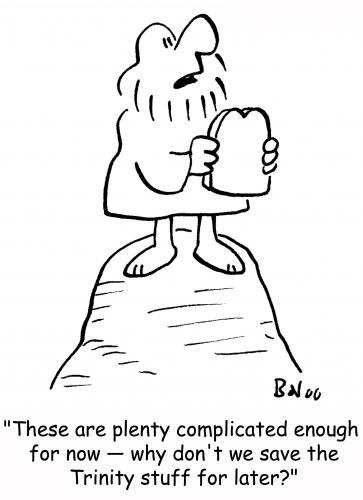
The Trinity, mysterious and befuddling as it may be, reflects the supernatural power and divine nature of God that is beyond our conceptual grasp as human beings. The Trinity challenges us to accept God on His terms, rather than trying to fit Him into a box of our own cognitive construction. The Trinity takes control away from us in our all-about-me world, and gives all glory to God. In other words, the Trinity prevents us from creating our own fictitious god and forces us to live by faith in a God that is bigger than we can understand. 

Interestingly, there is a universal trait that all cults and false religions hold in common: they all reject the Trinity. I have yet to learn of a cult or religion outside of Christianity that accepts the doctrine of the Trinity. Indeed, Mormons claim Jesus died on the Cross to atone for our sins. Jesus is also seen by Mormons and in much New Age thought as divine. Islam teaches that Jesus was a great prophet. Jehovah's Witnesses believe He was an archangel. But He is never accepted by any false religions as part of a triune Godhead, equal to God the Father and God the Holy Spirit. The significance of this cannot be overstated. 

But because the word, Trinity, is found nowhere in the bible, the concept is passed off by some as a theological invention that was added later to Christian doctrine, but is not necessarily integral to Scripture. This has led some Christians to downplay or misunderstand the crucial importance of the doctrine of the Trinity. For example, I felt prompted to write this blog post after hearing mature believers I know make statements like, "the Trinity isn't actually in the bible," and "maybe there are more than three members of the Godhead, but we just don't know about them." Sometimes, people treat the Trinity like a theoretical interpretation, a footnote, or something better left to theologians and seminary students.

But the Trinity is fundamentally important to the Christian faith, and Scripture makes this abundantly clear. Toward the end of His ministry, Jesus alluded to His rightful position as being equal to, and the same as, God, stating: “I and the Father are One” (John 10:30). Jesus showed that He was God when He said to the Jews in the temple, “Truly, truly, I say to you, before Abraham was, I am.” (John 8:58). The Trinity was understood by the early church. The opening statement of John's Gospel famously captures the truth of the Trinity: "In the beginning was the Word, and the Word was with God, and the Word was God. He was with God in the beginning. Through him all things were made; without him nothing was made that has been made." (John 1:1-3). And in verse 14 we learn that: “the Word became flesh and dwelt among us, and we have seen his glory, glory as of the only Son from the Father, full of grace and truth.” (John 1:14). The Word refers to Jesus Christ. Jesus also demonstrated that He had the power to forgive sins (Mark 2:1-12) as only God can, and Scripture tells us clearly that there is only one God (Deut. 4:35, 2 Sam. 22:32; Isa. 37:20; John 5:44; Rom. 3:30; 1 Cor. 8:4-6; Gal. 3:20; Eph. 4:6; 1 Tim. 1:17; James 2:19; Jude 25). As believers we are commanded by Jesus to go in the name (not names) of the Father and of the Son and of the Holy Spirit (Matt 28:19). These are just a few examples of how the truth of the Trinity is consistently woven throughout Scripture. There have been many, many biblical commentaries on this and mature believers should be aware of it.

The Trinity is central to the Christian faith and should not be marginalized. It is the basis for our belief in the unique and innate deity of Christ. Those who deny the Trinity open the floodgates to all sorts of heresy, including polytheism and self-deification as in the Mormon faith and New Age philosophies, or the reduction of Jesus to mere man, prophet, or good teacher.

Despite this, many believers choose to downplay the significance of the Trinity, which is often due, it seems, to the growing influences of pluralism and political correctness in our society. Engaging in interfaith dialogue, for example, is an increasingly popular form of outreach in American churches (e.g. Rick Warren's Saddleback Church). During such dialogues between people from different faiths, there is a tendency to stick to safe topics that highlight common ground between religions to promote friendship and peace. The Trinity, which is a polarizing deal-breaker when seeking common ground, is often conveniently ignored by Christians during these sessions. 

The intention behind interfaith dialogue is most often a good one: to reach out in the love of Christ to our neighbors. Jesus was clear that this is highly important when He said to the Pharisees “‘Love the Lord your God with all your heart and with all your soul and with all your mind.’ This is the first and greatest commandment. And the second is like it: ‘Love your neighbor as yourself.’ All the Law and the Prophets hang on these two commandments.” (Matt 22:35-40). What is debatable, however, is whether interfaith dialogue is a biblically sound way to fulfill this commandment. It is doubtful that any dialogue that results in watering down the gospel and glossing over the stumbling block that is Christ's true identity is not actually showing love to one's neighbor at all.

John Piper put it well: "...we would be happy to sit down with any Muslim group and commend Christ to them, and let them talk to us about their prophet, but we’re not going to smooth things over and talk in vague language about how we have the same God and the same love of God, call Mohammed a prophet, call Jesus a prophet, quote Scripture selectively so that it sounds just like the Koran, we’re not going to do that."

Former US Congressman, and self-described evangelical, Mark Silanjer, in his recent book, A Deadly Misunderstanding, writes about his experiences seeking common ground between Islam and Christianity. In dialoguing with Muslim clerics and leaders in the Middle East, he found that the biggest “stumbling block” he encountered was “always about Jesus.”[1]  This is not surprising; the pivotal nature of Christ's work on the Cross will always present an obstacle to those seeking common ground with other religions. But Silanjer, in his quest for compatibility, passes off this stumbling block [the biblical view of Jesus Christ] as a “diversion.”[2]  In his effort to promote love, peace, and friendship between neighbors, Silanjer ends up glossing over the Trinity, saying he respects the idea, but “nowhere is it to be found in the Bible”  (an increasingly common argument that is thrown about today). Silanjer finds the “attributes of Deity—God, Holy Spirit, and Messiah” to exist in the Torah, the New Testament, and the Qur’an alike. He explains how he has “asked distinguished clerics, both Muslim and Christian, if they could explain to me the interaction of these three deified attributes, and after much bantering back and forth, in the end they all have given me the exact same answer: ‘Mark, it’s a mystery.’ So what are we all arguing about?” Silanjer’s implication that the Trinity holds little significance because it is a mystery, and his description of three “attributes” in place of three Persons in one God, shows a radical departure from biblical teaching. He marginalizes the Trinity, passing it off as a “theological red herring,” and implies that it should be by-passed as an inconvenient barrier to true peace and reconciliation.[3] Silanjer exemplifies for us how seeking common ground between faiths can quickly end in theological syncretism if the end goal is friendship and compatibility above all.

Not all interfaith dialogue leads to such extreme misuse of Scripture. Seeking common ground with Muslims can be helpful as a starting point in initiating spiritual conversations with Muslim friends. Muslims admire Jesus and claim Him as a prophet of Islam. To talk about Jesus with a Muslim can be useful because they already respect who they think He is. It is not generally advisable to begin conversations with Muslim neighbors by laying out all our theological differences. But the motive behind reaching out to unbelievers, should ultimately be to share the gospel, not just to make friends as an end goal. Otherwise, we have moved from pleasing God, to pleasing people alone. There is certainly a danger that through the process of interfaith dialogue the original intention to spread the gospel is obscured, and relativistic compromises made, in an effort to maintain the amicable relations that have been established. But in reaching out with the love of Christ to our Muslim neighbors, we must not lose sight of the fact that ultimately we preach Christ crucified: a stumbling block to Jews and foolishness to Gentiles (1 Cor 1:23). [Incidentally, most Muslims do not believe that Jesus was crucified, but that He was taken up to Heaven without actually dying on the cross. Therefore, they deny the resurrection].

In the end, the Trinity can be a deal-breaker in interfaith relations and we need to be okay with that. If we choose to gloss over or deny the truth about Jesus we are committing a grave sin against God. Jesus said, "But whosoever shall deny me before men, him will I also deny before my Father which is in heaven. Think not that I am come to send peace on earth: I came not to send peace, but a sword. For I am come to set a man at variance against his father, and the daughter against her mother,  and the daughter in law against her mother in law." (Matt 10:34-36).

The world will reject Christ. But we are empowered by the Holy Spirit to go and make disciples of all nations (Act 1:8; Matt 28:19). Even though it is tempting to finesse or tweak the gospel in ways that might appeal to different people, we should stop over-thinking it and stop doubting in the power of the Holy Spirit to convict hearts. All we need to do is surrender ourselves to God, serve others in Christ-like love, and be always be ready to explain, with gentleness and respect, why our hope is in Christ (1 Peter  3:15).


[1] p137
[2] p137
[3] p146

Monday, November 18, 2013

Are Mormons Saved if They Believe in Jesus as Savior?

Due, in part, to an aggressive emphasis on missions, Mormonism is the fastest growing religion in America. With an increasing number of people committing their lives to the Mormon Jesus as their savior, it is important for us to know who this influential figure is and what he stands for. 

In 2011, in a special report to CNN, Richard J. Mouw, then president of Fuller Theological Seminary, an evangelical school in Pasadena, California, described how he had engaged in “behind-doors dialogue” with Mormon theologians from Brigham Young University along with a dozen other evangelicals. He noted that “Brigham Young University is a world-class educational institution, with professors who’ve earned doctorates from some of the best universities in the world. Several of the top leaders of the Church of Jesus Christ of Latter-day Saints have PhDs from Ivy League schools.” After describing the academic credentials represented by Mormon theologians and top leaders, Dr Mouw concluded his article by stating that Mormonism is not a cult, adding, “While I am not prepared to reclassify Mormonism as possessing undeniably Christian theology, I do accept many of my Mormon friends as genuine followers of the Jesus whom I worship as the divine Savior.”[1]


I contacted Dr. Mouw for clarification and he kindly reasserted his position to me, explaining that he had just spent two days in Salt Lake City with top leaders of the Church of Jesus Christ of Latter-day Saints whom he had found to be placing new emphasis on Jesus as the only Savior, who died on the Cross, shedding his blood as a sacrifice for our sins, rather than on works as a means to earn salvation. Dr. Mouw expressed his belief that people can be wrong or confused about many theological issues and still be saved by the work of the Cross.


In conversations with Christian friends over the years, I have heard similar sentiments to those articulated by Dr. Mouw, especially after American Christians were confronted with the implications of a potential Mormon president in 2012. Many Christians are struck by how committed their Mormons friends are to following Jesus and are impressed by their moral standards and social conservatism. If Mormons fervently claim Jesus as their savior, should this not mean, therefore, that they are saved?


This is evidently a confusing issue for a significant number of Christians. Indeed, much of the language of Mormon theology connotes biblical-sounding ideas. For example, Mormons believe that Jesus is “the way.” This is familiar language for many Christians, which seems at first glance to mirror evangelical soteriology. Indeed, the Church of Jesus Christ of Latter-day Saints (LDS) upholds Jesus as central to their doctrine, and He is proclaimed to be the only Messiah, and the only way to the Father. Mormon Scriptures declare that Christ is the only name under heaven whereby salvation comes (2 Ne. 25:20). As the official website of the LDS states: “Jesus Christ is the Savior of the world and the Son of God. He is our Redeemer…Only by His mercy and grace can anyone be saved…Jesus Christ saves us from sin and death. For that, he is very literally our Savior and Redeemer.” Certainly, this language sounds biblical.


LDS Church President Gordon B. Hinckley encourages members of other faiths to bring all the goodness of their belief in Jesus Christ and “let us add to it.” [2] Mormonism certainly adds many qualities to the biblical Jesus—and it subtracts plenty too. If one delves more deeply into Mormon Christology, fundamental deviations from the biblical view of Jesus become starkly evident. 


Firstly, Mormon theology rejects the TrinityMormons believe in three distinct and separate members of the godhead. The Doctrine and Covenants, one of the four sacred books of Mormonism, states, “Christ, the Firstborn, was the mightiest of all the spirit children of the Father.” In other words, Jesus is not eternally God, nor an innate Person of the Trinity, but was begotten as a spirit baby of the Heavenly Father, a physical God of flesh and bones,[3] through sexual relations with a spirit mother. Being one of many begotten offspring of God the Father, Jesus is, therefore, not one with God, nor is he unique in his deity. 

Why is this significant? Because it is a complete deal-breaker. The Mormon rejection of the Trinity is a denial of Jesus’ own claim that He and the Father are one and the same (John 10:30; John 14:7). While the Mormon Jesus may be divine, his is a derived form of divinity, which is neither unique to him nor inherent in him. Milton R. Hunter[4] wrote, “Jesus became a God and reached His great state of understanding through consistent effort and continuous obedience to all the Gospel truths and universal laws.”[5] In other words, Jesus became divine through works, like the Father before him. In Mormon theology, then, the Father and Jesus are neither innately nor uniquely divine as part of the Trinity. The Mormon denial of the Trinity paves the way for polytheism and ultimately for self-deification in the Mormon faith; If divinity is gained through faith and works, then all men possess the potential for godhood. 

The LDS tenet that men can become gods was famously coined in a couplet by fifth LDS President Lorenzo Snow. In June of 1840, Snow declared, “As man is, God once was; as God is, man may become.” Because Jesus represents a necessary path--indeed the only way--to self-deification, an eternal relationship with God is not the end result of our salvation, but merely a means to our own godhood. The Mormon gospel, then, is fundamentally different from what the bible proclaims to be the good news. The end goal for a Mormon is to be a god of his own world, where he will procreate with his celestial wife and populate his own planet with spirit babies. This is the highest reward granted by the grace of God, based on faith and works.


The Mormon Jesus is, therefore, a counterfeit who bears little resemblance to the authentic Christ, when he is removed from the Trinity, relegated to the level of one supreme god among gods, and extracted from the true gospel. The Mormon Jesus may even himself have fathered children[6] and had wives[7]. What is worryingly overlooked by Dr. Mouw and others who seek common ground with Mormonism is that the Mormon Jesus is an insidious counterfeit, a wolf in sheep's clothing, that must be rejected, not befriended. He quite simply is not the same Jesus.

Despite the fundamental differences between biblical and Mormon Christology, however, the “Christ”-centeredness of Mormonism, and their new emphasis on grace, has led some to argue that it is not a cult and to perceive the religion as close to Christianity, if not qualifying to be a denominational part of it. There has been of late a great effort from within the LDS Church to be reclassified as a Christian denomination, which might be why their more blatantly heretical theology is found only by digging more deeply into the content of the official LDS website and teaching manuals, for example. After perusing the LDS website thoroughly a couple of years ago, I was horrified to find later that much of the more descriptive information about Mormon theology I had previously seen was removed altogether prior to the presidential election of 2012 in which self-professed Mormon, Mitt Romney, endeavored to win the evangelical vote. 


So, are Mormons saved? Is following a distorted version of Jesus sufficient? How wrong can one be about Jesus, and still be saved by Him? This is a difficult question to answer. No one except God can know the heart of a person and it is certainly not our place to judge. I am sure there are many Mormons who are truly seeking Jesus by intention and I am not willing to take a position on the status of any individual’s salvation. It is clear, however, that the Mormon Jesus does not represent the way, the truth, and the life because who he is, and where he leads, is fundamentally at odds with the authentic Son of God and the Gospel of Christ. 


Jesus taught that truly knowing Him is vital; He said: “If you really know me, you will know my Father as well.” (John 14:7). The Bible also states, “You will seek me and find me when you seek me with all your heart.” (Jer. 29:13). It is doubtful that one can truly find God if one’s heart is divided, and is ultimately seeking after self-deification rather than God alone. 


In the end, the leaders of the LDS Church will have a lot to answer for, for they will be held to a higher standard of judgment and will be accountable for leading others astray (James 3:1). Jesus warned us of the serious ramifications of misusing His name when He said, “Not everyone who says to me, ‘Lord, Lord,’ will enter the kingdom of heaven, but only the one who does the will of my Father who is in heaven. Many will say to me on that day, ‘Lord, Lord, did we not prophesy in your name and in your name drive out demons and in your name perform many miracles?’ Then I will tell them plainly, ‘I never knew you. Away from me, you evildoers!’" (Matt 7:21-23). It is worth noting here that Jesus doesn't beat around the bush and seek common ground with those who misuse His name. In light of this, we should always be prepared to address the truth should God open up the opportunity in a conversation with a Mormon friend or acquaintance. As Christians, we are to be witnesses to His truth, which should always be expressed in His love.

Many Mormons are genuinely seeking after God. Refraining from lambasting Mormons, and bombarding them with our misgivings about their faith is important. While it is useful to be aware of what Mormons believe, we should also be sensitive to the fact that many Mormons are passionate about their faith, and attacking it outright will lead to a defensive reaction, and likely further them even more from the truth. We should always speak the truth in love (Eph 4:15) with gentleness and respect (1 Pet 3:15). 


Furthermore, it is of vital importance for us as Christians to have a firm, biblically sound grasp on what we believe. It is by staying well-grounded in the Word that we are able to accurately discern the distinction between Mormon and biblical views on Jesus, and not get confused by the similarities. Then, with confidence, we can share the true Christ with our Mormon friends and avoid getting caught up in interfaith dialogue that can lead to smoothing over our differences and ultimately watering down the gospel. 


As Christians, we should come together in prayer for truth-seekers to rise up within the LDS Church, that their hearts will be ill-at-ease within them, causing them to see the fatal flaws within Mormon theology, and that they will be drawn to seek after and to find the authentic Son of God. 

--------------------------------------
[1] “My Take: This evangelical says Mormonism isn’t a cult,” Richard Mouw, CNN. Oct 9, 2011. Emphasis added.
[2] "Words of the Living Prophet: INSIGHT AND COUNSEL FROM PRESIDENT GORDON B. HINCKLEY," www.lds.org
[3] Joseph Smith, Journal of Discourses, vol. 6, p. 3.
[4] Milton Hunter was a leader in The Church of Jesus Christ of Latter-day Saints, and served as a member of the church’s First Council of the Seventy from 1945 until his death in 1975.
[5] Milton Hunter, G.T.A., p. 51, (emphasis added)
[6] For example, Orson Hyde said, “Before the Savior died, He looked upon His own natural children, as we look upon ours.” (J. of D., Vol. II, p. 82).
[7] Many leading Mormons have taught that Jesus was married and was even a polygamist.